/

/

Balance Points, Where Consistency Begins

Balance Points, Where Consistency Begins

CODE

INTENTION

Beginner

duration

04:32

publish date

what you'll learn

Natural Movement

Equal and Opposite Pressure

System Stability

Self-Diagnostics

Lesson details

Most golfers search for consistency in their swing, but never build the system that creates it.

In reality, inconsistency comes from two places: not understanding your natural movement or not training it with structure. When your process changes, your results will always change.

This lesson introduces a simple but powerful shift, awareness. Awareness of whether you are playing or training, and awareness of how your body (the engine) is moving. Because before you can create speed or power, your body must first learn to stabilise.

Balance points give you a reference system to organise your movement. When the body moves in harmony, consistency follows. When it doesn’t, the swing becomes unpredictable.

Understand this and you stop chasing results, you start building them.


🚨 FOR REAL GOLF ANORAKS ONLY — DO NOT READ UNLESS YOU’RE IN THE 0.01% CLUB.

Balance Is Organising Your System

Pete’s concept of “swing in balance” is supported by modern biomechanics. Balance is governed by the relationship between the body’s centre of mass and its base of support. When these remain coordinated, movement becomes efficient and repeatable.

The spine angle acts as the central axis of this system. It can and does move in elite players but it moves in the correct way, around a centred system. Understanding movement around this centre begins with Level 1 (feet together), where the system is simplified. Level 2 (wide stance) allows for greater exploration of movement, force, and dynamics.

The key principle remains the same:

The upper and lower balance points must work in harmony.

This is not forced but is a natural organizing behaviour of the body. They are constantly working to stack and re-stack over one another to maintain balance. Excessive or misdirected movement disrupts this relationship and forces compensations elsewhere in the chain.

The Science of “Swinging in Balance”

Force plate studies show that elite players maintain controlled pressure shifts while keeping their centre of mass within a stable operating range but more importantly, they move correctly in relation to the interaction between upper and lower balance points.

Cause → Effect (What Really Happens)

• Lose knee stability → lower balance point destabilizes

• Lose chin control → upper balance point shifts excessively

• Lose spine organization → centre of mass moves outside control

• Result → loss of strike, direction, and power

The Biggest Misconception

Many believe this chain reaction happens in stages. While this is useful for training, it is not how the swing operates in real time.

A golf swing lasts approximately 1.5 seconds.

Under pressure, with ball flight as the focus, conscious control is not possible.

Instead, these reactions are instantaneous and subconscious which is the natural result of a well-trained system.

As Peter Cowen puts it:

“What comes first - the push or the pull?” They happen together. We do not train balance at the end of the swing. We build it from the start and maintain the natural organisation of movement throughout. Swing in balance, not by restricting it, but by allowing the system to work.

This is The Spiral Code.

Read More

Most golfers search for consistency in their swing, but never build the system that creates it.

In reality, inconsistency comes from two places: not understanding your natural movement or not training it with structure. When your process changes, your results will always change.

This lesson introduces a simple but powerful shift, awareness. Awareness of whether you are playing or training, and awareness of how your body (the engine) is moving. Because before you can create speed or power, your body must first learn to stabilise.

Balance points give you a reference system to organise your movement. When the body moves in harmony, consistency follows. When it doesn’t, the swing becomes unpredictable.

Understand this and you stop chasing results, you start building them.


🚨 FOR REAL GOLF ANORAKS ONLY — DO NOT READ UNLESS YOU’RE IN THE 0.01% CLUB.

Balance Is Organising Your System

Pete’s concept of “swing in balance” is supported by modern biomechanics. Balance is governed by the relationship between the body’s centre of mass and its base of support. When these remain coordinated, movement becomes efficient and repeatable.

The spine angle acts as the central axis of this system. It can and does move in elite players but it moves in the correct way, around a centred system. Understanding movement around this centre begins with Level 1 (feet together), where the system is simplified. Level 2 (wide stance) allows for greater exploration of movement, force, and dynamics.

The key principle remains the same:

The upper and lower balance points must work in harmony.

This is not forced but is a natural organizing behaviour of the body. They are constantly working to stack and re-stack over one another to maintain balance. Excessive or misdirected movement disrupts this relationship and forces compensations elsewhere in the chain.

The Science of “Swinging in Balance”

Force plate studies show that elite players maintain controlled pressure shifts while keeping their centre of mass within a stable operating range but more importantly, they move correctly in relation to the interaction between upper and lower balance points.

Cause → Effect (What Really Happens)

• Lose knee stability → lower balance point destabilizes

• Lose chin control → upper balance point shifts excessively

• Lose spine organization → centre of mass moves outside control

• Result → loss of strike, direction, and power

The Biggest Misconception

Many believe this chain reaction happens in stages. While this is useful for training, it is not how the swing operates in real time.

A golf swing lasts approximately 1.5 seconds.

Under pressure, with ball flight as the focus, conscious control is not possible.

Instead, these reactions are instantaneous and subconscious which is the natural result of a well-trained system.

As Peter Cowen puts it:

“What comes first - the push or the pull?” They happen together. We do not train balance at the end of the swing. We build it from the start and maintain the natural organisation of movement throughout. Swing in balance, not by restricting it, but by allowing the system to work.

This is The Spiral Code.

Read More

About Author

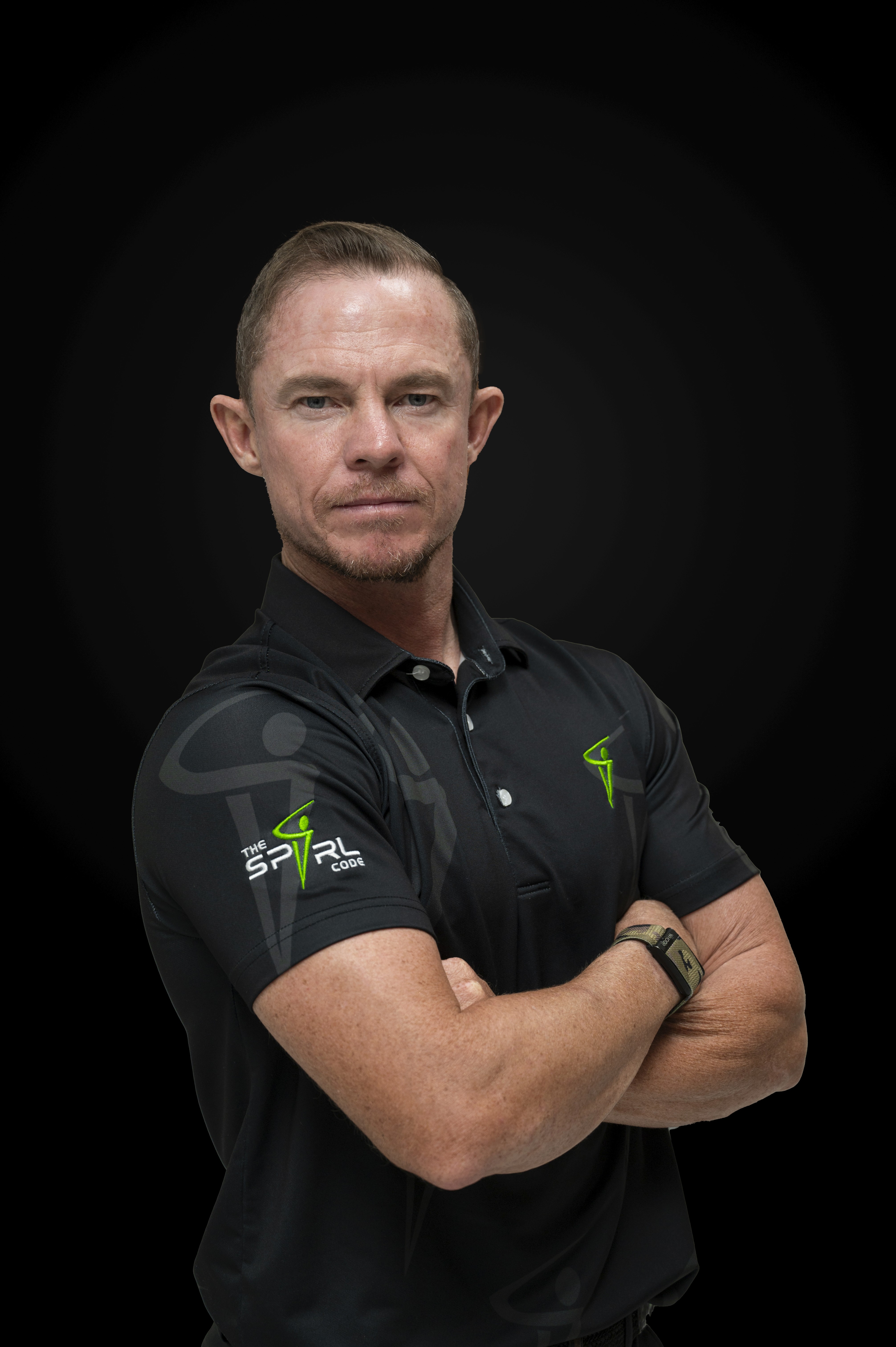
Jonathan Craddock

The Spiral Code Director of Instruction & Peter Cowen Master Coach

Jonathan Craddock is an elite performance coach with The Spiral Code, teaching globally through personal tuition and golf schools. Jonathan brings over two decades of experience to his role. He specializes in designing tailored programs for golfers of all levels, from junior elites to aspiring professionals.


Jonathan began his career under the mentorship of David Dunk, a retired UK tour player whose dedication and ethos left a lasting impact. His commitment to continuous learning was further inspired by Peter Cowen's own pursuit of improvement, even amidst success. Jonathan embraces this philosophy, striving to help his students reach new heights in their game.
Throughout his career, Jonathan has created and implemented golf development programs for schools, colleges, and federations.  One of his notable initiatives, The Peter Cowen Junior Development Program, will be available to you soon inside of the members area.


Qualifications
With 20 years of teaching experience, Jonathan Craddock is a Master Peter Cowen Professional and an Advanced PGA Qualified Instructor. He is a Level 3 member of the Club Managers Association of Europe, demonstrating his extensive knowledge of golf coaching and club management.


Jonathan's qualifications include a comprehensive range of specialized certifications, ensuring a well-rounded approach to golf instruction.

Level 3 Qualified Personal Trainer
Level 2 Golfing Machine Instructor
Titleist Performance Institute (TPI) certified in Junior, Golf Mechanics, Power, and Fitness
Dr. Kwon Biomechanics Level 2 certified
Paul Chek Biomechanics certified
K-Motion Biomechanics certified
BodiTrak Ground Force Mechanics certified
Trackman University Level 2 certified
GravityFit qualified

Be notified of new courses as soon as they drop

Unlock All Lessons

Join the Spiral Code to gain access to our elite library

Unlock All Lessons

Join the Spiral Code to gain access to our elite library